Market Scenario
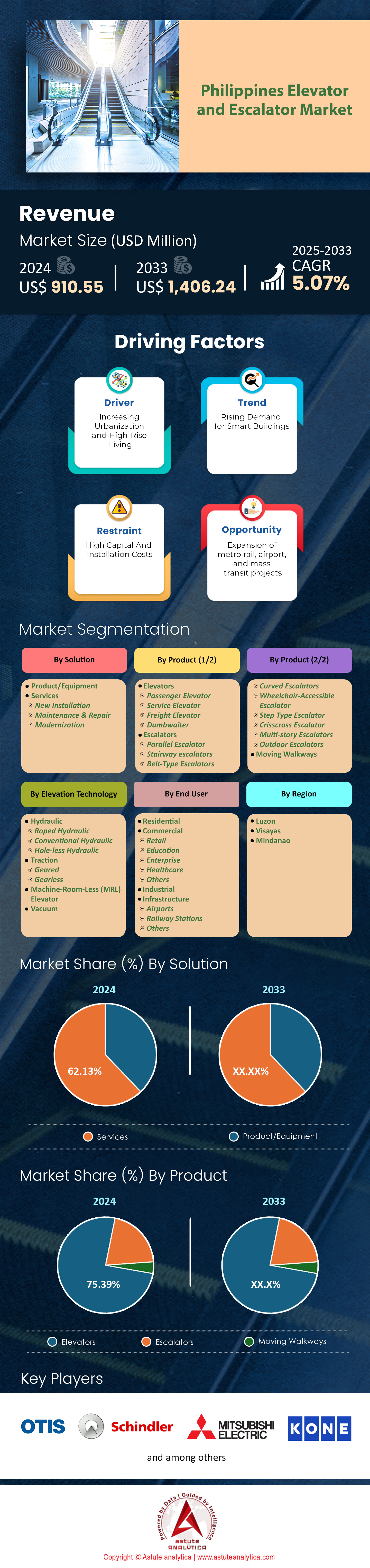
Philippines elevator and escalator market size was valued at US$ 910.55 million in 2024 and is projected to hit the market valuation of US$ 1,406.24 million by 2033 at a CAGR of 5.07% during the forecast period 2025–2033.
Key Findings
- Based on component. Services segment (New Installation, Maintenance & Repair , Modernization) accounts the largest 62.13% revenue share of the Philippines elevator and escalator market .
- Based on product type, elevator takes the lead in the market with over 75.39% share of the market.
- Based on technology, traction technology is heavily deployed in elevator and escalator across the Philippines as it control the highest 70.44% market share.
- Based on end users, commercial consumers are leading the consumers of the market by accounting for 31.53% market share and they install and buy them on large scale.
The current trajectory of the Philippines elevator and escalator market is fundamentally anchored by a synchronization of aggressive government spending and a corporate leasing renaissance. The demand landscape has shifted from speculative real estate building to tangible infrastructure delivery, primarily funded by the National Budget allocation for 2025. With a staggering P1.507 trillion specifically earmarked for infrastructure outlays, the state has effectively guaranteed a pipeline of heavy-duty equipment orders. This capital injection is not merely theoretical, it is materializing in projects like the Metro Manila Subway, where the construction of 17 confirmed stations necessitates complex vertical mobility networks. Each station represents a multi-unit installation contract comprising high-capacity escalators and accessibility elevators, creating a baseline of demand that insulates the industry from private sector volatility.
Simultaneously, the private commercial sector in the Philippines elevator and escalator market provides a powerful secondary demand engine, defying earlier fears of a post-pandemic slump. The resurgence of the IT-BPM sector has been a decisive factor, now accounting for 45% of total office demand as of 2025. This structural shift in tenancy is crucial because BPO operations typically run on 24/7 schedules, accelerating the wear and tear on vertical transport systems and necessitating robust, high-speed units. With year-to-date office demand hitting 966,000 sqm by October 2025, landlords are under immense pressure to fit out buildings with reliable systems to attract multinational tenants. Even with a generalized Metro Manila office vacancy rate of 18%, prime districts remain tight, compelling property owners to invest in premium elevators to maintain asset competitiveness. Thus, the Philippines elevator and escalator market is currently running on dual engines—public transit volume and private corporate efficiency.
To Get more Insights, Request A Free Sample
Opportunity: Provincial Expansion and Tourism Recovery Unlock Strategic Regional Installation Opportunities
Beyond the saturated capital, significant opportunities are crystallizing in key regional growth centers, particularly in the Visayas and Mindanao regions. Developers are aggressively decentralizing their portfolios to capture the urbanization spreading outward from Manila. A prime example of this trend is Cebu Landmasters, which has committed to a massive pipeline with P36 billion in new project launches scheduled between 2025 and 2026. This geographical diversification opens untapped territories for the Philippines elevator and escalator market, where installation margins can often be higher due to less saturated competition. The shift is not limited to office towers; it extends deeply into the retail sector. SM Prime’s allocation of P21 billion specifically for new mall construction in 2025 signals that the "malling" culture remains a dominant force. These large-format retail developments are capital-intensive regarding mobility, requiring extensive banks of escalators to manage heavy foot traffic in provinces where consumer spending is rising.
The hospitality sector offers another high-value vertical for equipment suppliers. As tourism rebounds, the need for vertical transport in hotels is expanding rapidly, moving beyond utility to become a core part of the guest experience. The current pipeline is robust, with 158 private hotel projects confirmed, which will collectively add 40,084 new keys to the national inventory. This surge is not merely a projection but a construction reality, driven by the government's target of attracting 7.7 million visitors. Luxury and high-rise hotels require sophisticated destination control systems and high-speed lifts that differ significantly from standard residential units. Consequently, the Philippines elevator and escalator market is witnessing a segmentation where premium suppliers can dominate the hospitality niche, leaving standard mid-rise residential contracts to cost-focused competitors.
Trend: Green Building Mandates and Smart City Ecosystems Redefine Procurement Standards
A defining trend reshaping the Philippines elevator and escalator market is the irreversible move toward green building standards and smart city integration. Corporate tenants and multinational investors increasingly refuse to occupy buildings that lack environmental certifications, forcing developers to procure elevators with regenerative drives and energy-efficient standby modes. In the premium district of Bonifacio Global City, the green building adoption rate has already reached 73%, setting a benchmark that is rippling across other central business districts. This trend creates a barrier to entry for lower-tier suppliers who cannot meet these technical specifications. The Philippines elevator and escalator market is evolving from a commodity game to a technology race, where energy savings are calculated into the total cost of ownership.
Furthermore, the rise of master-planned smart cities is creating demand for interconnected mobility ecosystems. New Clark City, with its ambition to support a 1.2 million population capacity, represents the apex of this trend. In such developments, elevators are not standalone boxes but connected nodes in a building management system, capable of predictive maintenance and traffic flow analytics. The integration of IoT (Internet of Things) allows for real-time monitoring, a feature now demanded by large-scale operators to minimize downtime. As these smart districts move from planning to construction, stakeholders in the market must pivot their value proposition from hardware reliability to software intelligence and connectivity.
Challenges: Mounting Residential Inventory and Skilled Labor Shortages Present Operational Hurdles
Despite the bullish outlook, the Philippines elevator and escalator market faces tangible challenges that stakeholders must navigate carefully. The residential condominium segment, historically a volume driver, is showing signs of saturation in the capital. Data indicates 79,400 unsold units in Metro Manila, leading to an inventory lifespan of roughly 31 months. This glut forces developers to be cautious with new launches, potentially slowing the volume of fresh orders for residential elevators in the short term. While the government’s P13 billion subsidy budget for social housing attempts to mitigate this by stimulating the affordable segment, the high-rise premium residential market may experience a cooling period. Suppliers heavily exposed to the mid-tier condo market might face delayed collections or deferred project start dates.
Operational challenges also loom over the industry. The sheer volume of simultaneous infrastructure projects creates a strain on skilled technical labor. Installing sophisticated systems requires certified technicians, and with major subways and airports under construction, the talent pool is stretched thin. The Philippines elevator and escalator market relies heavily on on-site expertise for installation and safety certification. A shortage of skilled manpower could lead to project delays, cost overruns, and safety liabilities. Companies that invest in training academies and local workforce development will likely navigate this bottleneck better than those relying solely on subcontracted labor.
Future Outlook: Escalating Modernization Needs in Aging Towers Drive Recurring Revenue Growth
Looking ahead, the most sustainable revenue stream for the Philippines elevator and escalator market lies in the modernization of aging assets. As the first wave of Metro Manila’s high-rise boom from the 1990s and early 2000s reaches the end of its equipment lifecycle, building owners face a critical choice: refurbish or lose tenants. The forecast for the modernization market values it at USD 52.6 million by 2030, a figure that underscores the scale of this opportunity. Retaining a Grade A building classification often hinges on replacing obsolete elevators with modern, destination-dispatch systems that improve traffic handling capacity.
This modernization wave allows the Philippines elevator and escalator market to decouple slightly from the volatility of new construction cycles. Maintenance contracts, which offer higher profit margins than new equipment sales, are becoming the financial backbone of major players. As density increases and buildings go taller, the reliance on vertical transport becomes absolute—a 40-story building cannot function with down lifts. Therefore, the market is maturing into a service-first industry, where long-term relationships and technical support capabilities are the ultimate differentiators. The outlook remains positive, balanced between the excitement of new infrastructure and the steady reliability of the service economy.
Segmental Analysis
Dominance of Maintenance and Repair Services in Philippine Vertical Transport Sector
The services sector reigns supreme in the Philippines elevator and escalator market due to the rapid aging of existing infrastructure in Metro Manila. Government agencies aggressively tendered maintenance contracts in 2024 to ensure public safety. For instance, the Department of Energy procured a comprehensive maintenance contract for Goldstar elevators. Similarly, the National Museum of the Philippines issued a tender for the preventive maintenance of its central vertical transport systems for fiscal year 2025. The Bangko Sentral ng Pilipinas also initiated a replacement project for service elevators at its La Union branch. These government-led initiatives highlight a consistent revenue stream for service providers beyond new installations.
Private sector modernization drives further cement this dominance. The Philippine International Convention Center allocated USD 200,000 for freight elevator replacement in 2024. Major players like Otis launched their Gen3T connected platform in August 2024 to enhance service uptime through remote monitoring. Meanwhile, Jardine Schindler secured a 2025 service agreement with Accor Asia, covering Philippine hotel properties. The Office of the Building Official in Makati mandated rigorous inspections in 2024, forcing building owners to invest in immediate repairs. Such regulatory pressure ensures that the service segment in the Philippines elevator and escalator market remains lucrative and indispensable for operational continuity.
- Sumitomo Corporation continues the extensive rehabilitation and maintenance of the MRT-3 rail line elevators throughout 2024.
- KONE deployed its 24/7 Connect AI-based predictive maintenance solution to Philippine clients in 2025 to reduce equipment downtime.
- SMC-led consortiums for the NAIA rehabilitation project have prioritized the modernization of terminal mobility systems starting late 2024.
Surge in High Rise Residential and Commercial Towers Boosting Elevator Demand
Elevators command the market share because urbanization in the Philippines demands vertical expansion over horizontal sprawl. The Philippines elevator and escalator market landscape is defined by massive skyscrapers like the 53-storey My Enso Lofts, which is nearing completion in 2025. Residential developers like DMCI Homes turned over multiple high-rise projects in 2024, such as The Atherton, necessitating hundreds of new units. Commercial giants are also contributing significantly; SM Prime is constructing three new malls in Laoag, La Union, and Zamboanga for 2025, each requiring banks of elevators.
Infrastructure projects further propel elevator installation numbers. The ongoing Metro Manila Subway project involves procuring heavy-duty elevators for its 15 stations scheduled for full operation by 2029. The New Senate Building, with a construction cost of USD 140 million, installed state-of-the-art lifts in 2024 to serve government officials. In the hospitality sector, the newly opened Solaire Resort North installed 42 massive elevator units to manage guest traffic. Mixed-use developments like the IPI Center in Cebu started construction in Q3 2024, guaranteeing future demand. The sheer volume of floors added annually in the Philippines elevator and escalator market makes elevators the undisputed primary product type.
- Altaire Tower in Makati, a major commercial project, reached completion in Q1 2025 with a full elevator core.
- The Lapu-Lapu Desalination Plant project initiated in 2024 includes administrative buildings requiring vertical transport.
- One Ayala South Tower added significant commercial elevator capacity to the Makati district upon its 2024 completion.
Widespread Adoption of Energy Efficient Traction Systems in Modern Buildings
Traction technology dominates the Philippines elevator and escalator market because it offers superior speed and energy efficiency required by modern high-rises. KONE launched its High-Rise MiniSpace DX in Southeast Asia in December 2024, featuring traction technology that optimizes performance for tall buildings. New buildings like Solaire Resort North utilized Schindler 7000 traction elevators to handle heavy passenger loads efficiently. This technology is essential for the speeds required in 50-storey structures like My Enso Lofts, where hydraulic alternatives are technologically unfeasible.
Efficiency mandates are a major catalyst for traction adoption. Regenerative drives in modern traction systems saved Philippine buildings up to 30% in energy costs during 2024 modernizations. KONE introduced UltraRope in 2024, a carbon-fiber traction medium that is 80% lighter than steel, reducing energy consumption further. Mitsubishi Electric also rolled out its NEXIEZ-Fit machine-room-less traction model in 2024 to compete in the mid-rise segment. The shift away from energy-intensive hydraulic systems is accelerated by green building trends. Even residential users are moving toward traction; Cibes Lift Philippines promoted eco-friendly screw-driven and traction hybrid lifts in 2025. The Philippines elevator and escalator market clearly favors traction for its reliability and operational savings.
- Otis introduced its Gen3T traction elevator platform in August 2024 to support smart city connectivity.
- The Makati Intra-City Subway project requires high-speed traction elevators for its deep underground stations.
- Makati OBO safety inspections in 2024 implicitly favored modern traction systems over aging hydraulic units for compliance.
Customize This Report + Validate with an Expert
Access only the sections you need—region-specific, company-level, or by use-case.
Includes a free consultation with a domain expert to help guide your decision.
Commercial Real Estate Expansion Driving Volume Purchases of Mobility Systems
Commercial entities are the primary buyers in the Philippines elevator and escalator market due to aggressive expansion in retail and office spaces. Colliers forecasts a massive 615,000 square meters of new office supply in 2025, creating immense demand for new installations. SM Prime Holdings allocated a staggering USD 1.9 billion for capital expenditures in 2025, largely for mall and commercial developments. The exit of POGO operators vacated 334,000 square meters of office space in late 2024, prompting landlords to upgrade facilities to attract traditional corporate tenants.
The hospitality and mixed-use sectors further amplify commercial demand. Solaire Resort North alone added 156,000 square meters of gross floor area in 2024, heavily reliant on commercial-grade mobility solutions. Leechiu Property Consultants recorded a live commercial demand of 494,000 square meters for 2025, signalling sustained procurement. SM Hotels expanded its portfolio with the Lanson Place opening in 2024. Infrastructure with commercial components, like the USD 500 million upgrade of New Bohol International Airport awarded in late 2024, also drives volume. The resilient BPO sector's expansion in Makati and Fort Bonifacio ensures that the commercial segment remains the backbone of the Philippines elevator and escalator market.
- Filinvest Buendia achieved full commercial occupancy in Q3 2024 following a major government lease.
- JLL projects 170,000 square meters of new office supply specifically in Manila City for 2025.
- Araneta Cyberpark Tower 3 completed construction in 2024, adding significant commercial vertical transport inventory.
To Understand More About this Research: Request A Free Sample
Regional Analysis
Luzon's Infrastructure Growth and Economic Centrality is Making it Leader in Philippines Elevator and Escalator Market
Luzon commands over 63.14% of the elevator and escalator market primarily because it remains the epicenter of the government’s "Build Better More" program. The allocation of the P1.507 trillion infrastructure budget for 2025 is heavily skewed toward mega-projects in this region. For instance, the Metro Manila Subway alone accounts for 17 confirmed stations, each requiring extensive heavy-duty escalator banks, a volume unmatched in the Visayas or Mindanao. Furthermore, the development of New Clark City in Central Luzon, designed for a 1.2 million population capacity, has shifted high-rise urbanization north of the capital. This concentration of public spending creates a baseline of equipment orders that naturally tips the market share heavily in Luzon's favor.
- Commercial Density and Corporate Consolidation
The region’s commercial maturity acts as a massive magnet for vertical transport demand, which in turn, strengthening the regions dominance in the Philippines elevator and escalator market growth. Metro Manila serves as the operational headquarters for the IT-BPM sector, which was responsible for 45% of the country's total office demand in 2025. With national office absorption hitting 966,000 sqm, the vast majority of these fit-outs occurred in Luzon's prime districts like BGC and Quezon City. Large-scale mixed-use developments exemplify this density; Solaire Resort North in Quezon City recently required the installation of 42 elevators and 25 escalators for a single asset. Additionally, the sheer volume of vertical living is concentrated here, evidenced by Metro Manila holding 79,400 units of high-rise condominium inventory.
- Hospitality Clusters and Gateway Dynamics
Even the tourism sector reinforces Luzon’s leadership position in the Philippines elevator and escalator market. Despite the popularity of island destinations, hard data shows that 50% of the nation's active hotel pipeline is physically located in Luzon. As the primary entry point for the 7.7 million tourist arrivals targeted for 2025, the region captures the bulk of casino-hotel and transit-oriented developments. With 4,300 new hotel keys scheduled to open in Q4 2025 alone, developers are prioritizing high-speed guest elevators in Metro Manila and the Bay Area. This synchronization of residential, commercial, and hospitality construction ensures Luzon remains the undisputed volume driver for the industry.
Top Players in the Philippines Elevator and Escalator Market
- Schindler Group
- Mitsubishi Electric Corporation
- Hitachi Elevator Philippines Corporation (Hitachi, Ltd.)
- Hyundaielevator Co.,Ltd.
- Access Lift & Electronics Corporation (GEEC)
- Asia PTS Elevator Inc.
- The Lift Company Philippines Inc.
- LIFTASIA
- Toshiba Elevator and Building Systems Corporation
- Otis Worldwide Corporation
- KONE Corporation
- Nippon Elevator
- Other Prominent Players
Market Segmentation Overview
By Product Type
- Product/Equipment
- Services
- New Installation
- Maintenance & Repair
- Modernization
By Product
- Elevators
- Passenger Elevator
- Service Elevator
- Freight Elevator
- Dumbwaiter
- Escalators
- Parallel Escalator
- Stairway escalators
- Belt-Type Escalators
- Curved Escalators
- Wheelchair-Accessible Escalator
- Step Type Escalator
- Crisscross Escalator
- Multi-story Escalators
- Outdoor Escalators
- Moving Walkways
By Elevation Technology
- Hydraulic
- Roped Hydraulic
- Conventional Hydraulic
- Hole-less Hydraulic
- Traction
- Geared
- Gearless
- Machine-Room-Less (MRL) Elevator
- Vacuum
By End User
- Residential
- Commercial
- Retail
- Education
- Enterprise
- Healthcare
- Others
- Industrial
- Infrastructure
- Airports
- Railway Stations
- Others
By Region
- Luzon
- Visayas
- Mindanao
LOOKING FOR COMPREHENSIVE MARKET KNOWLEDGE? ENGAGE OUR EXPERT SPECIALISTS.
SPEAK TO AN ANALYST
.svg)

 Schedule a Meeting

Features | Type of License | ||||
 Data Book | Single User |   Multi User |  Corporate | ||
| e-Access | ✓ | ✓ | ✓ | ✓ | |
User Sharing | 1 User Only | 1 User Only | Up to 7 Users | Unlimited User Access | |
⨉ | ⨉ | ⨉ | ✓ | ||
Free Customization | No Free Customization | Up To 30 hrs work | Up To 60 hrs work | Up To 80 hrs work | |
Deliverable |
| ⨉ | ✓ | ✓ | ✓ |
| ✓ | ⨉ | ✓ | ✓ | |
| ⨉ | ⨉ | ⨉ | ✓ | |
Analyst Support | 2-Months Analyst Support | 4-Months Analyst Support | 7-Months Analyst Support | One Year Analyst Support | |
Free Report update in next update cycle | ⨉ | ⨉ | ⨉ | ✓ | |
Free Industry Update (Within 180 days) | ⨉ | ⨉ | ⨉ | ✓ | |
Benefit | Up to 10% off on Post Purchase | Up to 20% off on Post Purchase | Up to 30% off on Post Purchase | Up to 40% off on Post Purchase | |